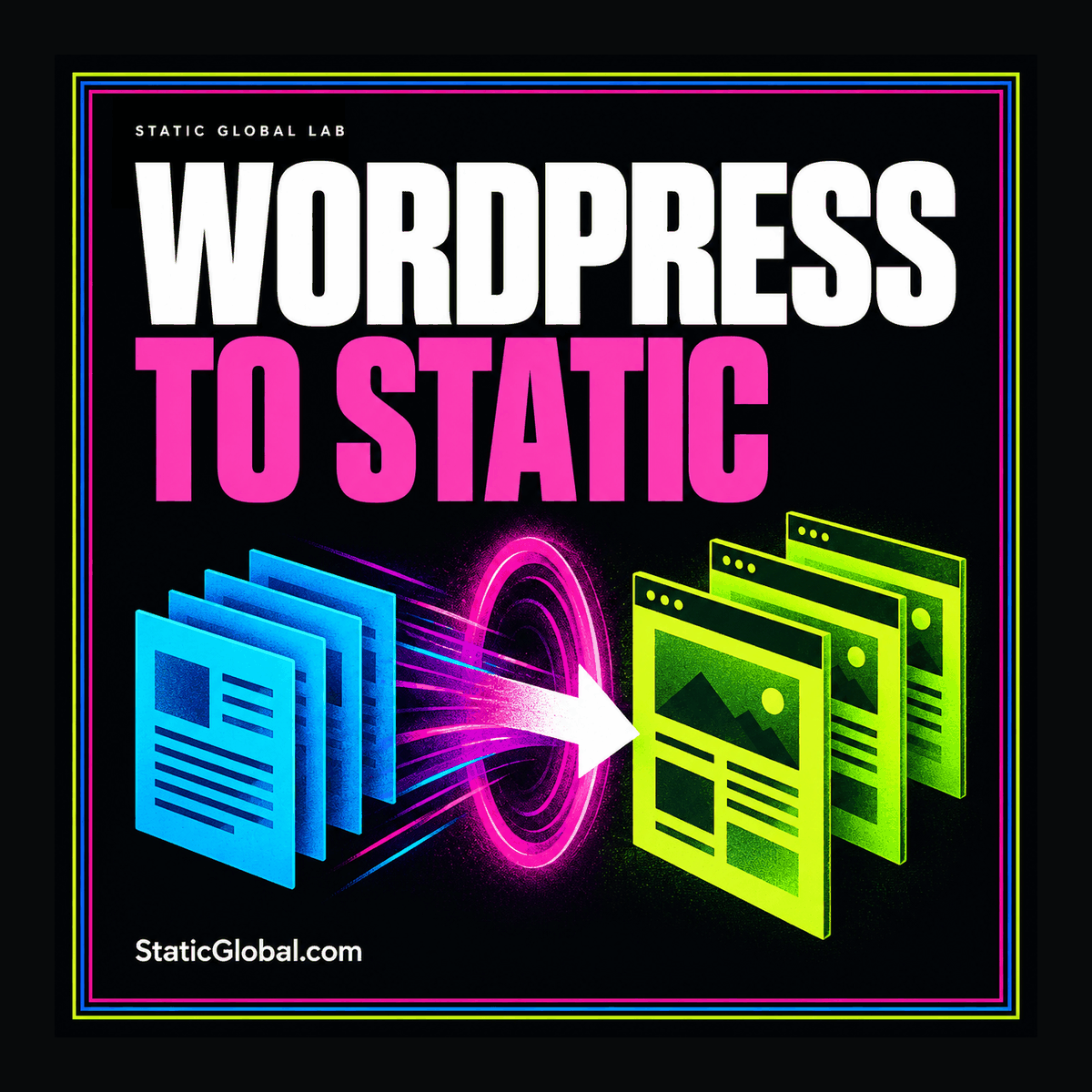
A WordPress to static migration is a publishing change, not just a file conversion. The visible pages may become HTML files, but you still need a way to edit content, preserve useful URLs, handle media, and release future updates. Before choosing an exporter or rebuilding templates, decide what the public website must do after the move and which parts of the existing installation are only needed for authoring.
This checklist is designed for an information site whose core content can be published in advance. It helps you separate straightforward pages from features that need a different plan. Work through the decisions before the final export, then validate the actual output. Our WordPress to static guide provides the broader architecture; this article focuses on the migration work that makes a launch repeatable.
1. Define the scope and a recovery point
Write down what you are migrating: published pages, posts, category archives, downloadable resources, media, and any custom content types. Also list deliberate exclusions such as obsolete campaigns or private drafts. Assign one person to approve those exclusions. Without a scope, a missing page can be mistaken for a planned cleanup, and nobody can confidently decide whether the export is complete.
Create a recoverable backup of the existing WordPress files and database before changing settings. Keep the backup outside the public deployment folder and verify that the team knows how to restore it. Save the existing domain and hosting configuration as well. A migration needs an explicit recovery point because the final static artifact does not replace the editable source, historical records, or operational configuration of the original installation.
2. Build a URL and content inventory
Create a manifest with one row for each public URL you intend to preserve. Record the page type, title, destination URL, important media, and any special behavior. Include paginated archives and documents that receive direct links. Use more than the homepage navigation as your source: older content may be reachable through archives, feeds, or links from other websites even when it is absent from the main menu.
Preserve existing paths wherever practical. For a clean URL such as /guides/launch/, a static deployment can provide a directory containing an index document. Check that the destination host serves that structure. If a URL must change, record the old and new destinations and establish a redirect method supported by your hosting environment. A redirect plan on paper is insufficient if the chosen static service cannot implement it.
3. Distinguish content export from page export
The built-in WordPress export is a content-transfer format. The official WordPress Tools Export documentation explains that it produces a WXR XML file containing selected content and associated data. That file is useful for migration, but it is not a ready-to-host folder of rendered HTML, stylesheets, and media. Choose a workflow that deliberately produces the public files you need.
There are two broad approaches to assess. You can capture rendered public pages while retaining WordPress as the editing environment, or move the content into a new static publishing system. The first approach emphasizes faithful rendering and export coverage. The second emphasizes content mapping, template reconstruction, and editor training. Test a difficult page early, such as a long article with embedded media and custom layout blocks, before committing to either path.
4. Decide what happens to dynamic features
List comments, forms, site search, account areas, commerce, personalized content, and any plugin feature that expects a running server. For each, choose an implemented replacement, an external dependency with an owner, or a clear removal. A captured search box does not become a working static search engine. A copied checkout page does not preserve order processing. Review behavior by following the visitor's action all the way to its expected result.
For a fully static information site, simple alternatives may be enough. An email link can provide a contact destination; topic archives can improve discovery without a search input. Preserve existing comment text as an archive only when you have a reason and the right content permissions. Remove submission controls that no longer work. Keep these decisions visible in the migration plan so an exporter does not silently reintroduce abandoned widgets.
Consider an event page with a schedule, a registration form, and a list of past speakers. The schedule and speaker biographies may be ordinary publishable content. Registration requires an explicit decision: link to an implemented registration destination, retain a separately operated service, or close registration and say so. Treating the page as one indivisible feature hides that distinction. Break similar pages into their visitor actions, then document the outcome for each. This produces a much clearer scope than labeling every page either static-compatible or unsuitable based only on its appearance.
5. Transfer content and media deliberately
Map each content field into the new page model. Include titles, summaries, body content, author attribution where applicable, original publication dates, categories, tags, image descriptions, and canonical destinations. Inspect how shortcodes and page-builder blocks are represented. Some elements need rendered output; others are better rebuilt as reusable components. Compare the resulting article to its source instead of assuming that a successful import preserved every meaning and relationship.
Copy the media needed by the published pages, including background images, responsive image variants, fonts, and downloadable files. Scan the output for references to the old editing domain or upload location. Open a representative set of images and documents from the new host. Maintain descriptive filenames where feasible, and avoid renaming files merely for cosmetic consistency when existing links depend on them.
6. Preserve discovery and page identity
Review page titles, descriptions, canonical URLs, heading structure, and internal links in the generated HTML. Update sitemap and feed entries to the final public URLs. Keep publication dates consistent with the content record, and reserve modification dates for real revisions. If an article changes substantially during migration, record the reason; moving it to a different hosting arrangement alone should not imply a fresh editorial update.
Make category and tag archives useful enough to navigate. A migration is a good time to consolidate confusing labels, but every consolidation should have a destination plan. Check that the homepage, navigation, and footer provide routes to the main subjects. Do not treat a sitemap as the only way readers can discover migrated material. Important content deserves descriptive links in the public website itself.
7. Establish the next publishing cycle
Decide who edits after launch and where they work. If WordPress remains the authoring environment, document how an approved edit triggers a new export and how access to that environment is maintained. If the content moves elsewhere, provide a sample publishing task that an editor can complete independently. The static CMS guide helps distinguish authoring tools from the files ultimately delivered to readers.
Test adding a new article, changing an existing image, correcting a URL, and withdrawing a page. Each operation should result in an understandable deployment, including removal of files that no longer belong in the public site. Keep previous releases for recovery without accidentally publishing backup directories. A migration is incomplete when the first export works but routine editorial changes require an undocumented rescue operation.
8. Rehearse the launch and rollback
Serve the candidate on a staging hostname that matches the intended hosting behavior. Protect staging appropriately, and verify that any temporary indexing restrictions are absent from the final public output. Check nested paths, direct downloads, mobile navigation, keyboard access, and the missing-page response. Our website converter guide explains conversion boundaries, and validating a static conversion provides a detailed artifact review.
Agree on a short content freeze or another method for capturing changes made during the final export. Record the source revision and candidate release. Publish only after the owner approves the URL manifest and essential visitor journeys. Rehearse restoring the previous site or previous artifact, including any domain and cache changes required. Assign a person to monitor the public result and resolve discrepancies after launch.
Conclusion: migrate the workflow as well as the pages
A dependable WordPress to static migration preserves the content people need while giving editors a sustainable way to maintain it. Inventory the site, protect a recovery point, make explicit decisions about dynamic features, and prove both launch and rollback. The final milestone is more than a working homepage: it is a complete public artifact and an editorial team that can confidently publish the next change.